A standard unit fits when the crowd is modest and the stay is short-to-medium. One standard toilet reasonably covers about ten workers on a 40-hour week with weekly service, and a weekend gathering of roughly 100…
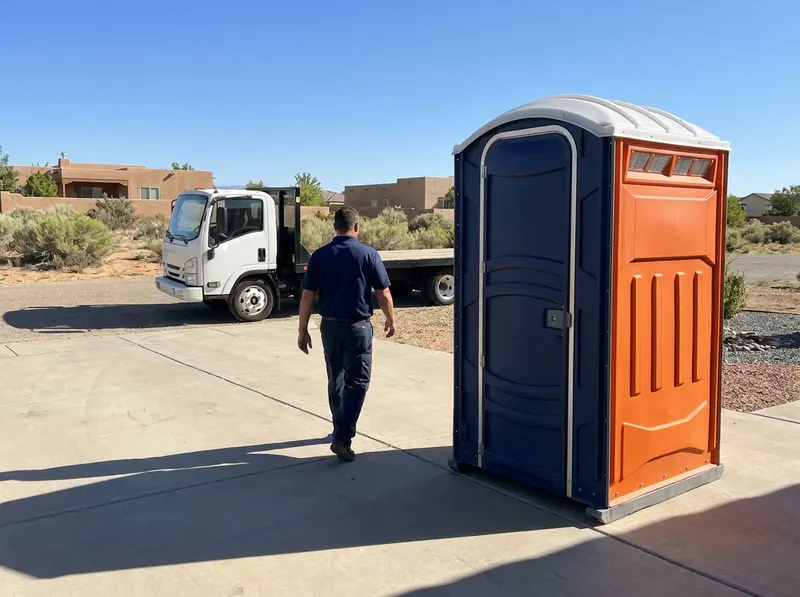
A standard unit fits when the crowd is modest and the stay is short-to-medium. One standard toilet reasonably covers about ten workers on a 40-hour week with weekly service, and a weekend gathering of roughly 100 guests over four hours. Above those numbers, the answer is usually a second standard unit rather than an upgrade — two basic toilets beat one crowded deluxe unit almost every time. Choose something other than a standard when the guest list is dressed up, when the event runs all day in July heat, or when you need a sink and interior light at the door; those are the cases where a flushing or ADA unit earns the difference in price. The trade-off with a standard is simple and worth stating plainly: no running water and no flush tank, so you rely on the sanitizer dispenser and the scheduled pump-out.
Placement matters more in Albuquerque than in flatter cities. West side lots around Volcano Cliffs sit on caliche and loose fill that shift under a full tank, so we look for a compacted pad or a flat spot near the driveway apron rather than the slope. In the North Valley and Los Duranes, older lots often have narrow gravel lanes, deep ditches, and low cottonwood limbs — our service truck needs about 12 feet of clear width and 13 feet of overhead to reach a unit, and the pump hose reaches a limited distance from where the truck can park. Nob Hill, Ridgecrest, and Netherwood Park have tight alleys and street parking on both sides, so a unit set on the front pad or the corner of the driveway is far easier to service on route than one wheeled to the back fence. Downtown and Barelas jobs frequently need the unit inside a construction fence or on a permitted sidewalk closure; check with the City of Albuquerque before the delivery date so the driver is not turned away.
The local climate shapes the service schedule. Spring winds off the West Mesa are strong enough to move an unsecured unit, so standard toilets on open ground near Petroglyph National Monument or on unfenced South Valley acreage should be strapped or staked, or set with the door facing away from the prevailing southwest gust. Summer heat and the dry air mean odor builds faster than the calendar suggests; on active summer jobs, many customers move from weekly to twice-weekly pumping between June and August and the difference is immediately noticeable. Winter is easier — freezing nights are common but the tank chemical keeps the contents workable, and units placed in sun on the south side of a structure stay more comfortable.
Event work has its own rhythm here. Balloon Fiesta Park, Old Town plaza events, the streets near University of New Mexico on game weekends, and the trailheads by Rio Grande Nature Center State Park all fill and empty in predictable waves, and standard units are the practical way to scale up for a single weekend. For events we set units in a line with doors facing the same direction, away from food service and upwind of seating, then pull them the following business day. Longer construction rentals near Tanoan or on Kirtland Air Force Base access roads run on a monthly cycle with weekly service, which spreads the cost and keeps the unit steady for the crew. Call (505) 201-1893 and we will look at the site, confirm the ballpark, and lock in a number before delivery.
Every job gets a firm, written price after a free on-site visit.
Tell us about your standard portable toilet rental job in Albuquerque and we'll send a clear, written quote — usually the same day.
 SafeZone Restroom Experts